Leadership is often portrayed as having all the answers. Setting the direction. Making the decisions. Driving performance.
But after more than 20 years leading teams, working with senior specialists and now running my own business, I've come to a different conclusion.
Building high-performing teams isn't about having all the answers. It's about creating the conditions for other people to do their best work.
I recently had the pleasure of discussing this with Anthony Donovan on his new Lead with Curiosity podcast. We explored everything from trust and burnout to accountability, culture and why great workplaces aren't built on perks alone.
Although we covered a lot of ground, one idea kept resurfacing throughout our conversation.
Great leaders remove blockers instead of creating them
Great leaders don't remove accountability. They remove the blockers that stop people from succeeding.
You can watch and listen to our conversation on Spotify here.
Whether you're leading a team of two or two hundred, your role isn't to have all the expertise. It's to create clarity, build trust and remove the obstacles that prevent talented people from doing their best work.
Trust is the foundation of building high-performing teams
When people ask me what the secret to building high-performing teams, my answer is always the same.
Trust.
Not the kind of trust that's printed on a corporate values poster, but genuine trust that gives people the confidence to speak up, challenge ideas, admit mistakes and take ownership without fear of being criticised.
Throughout my career, I've led teams of experienced specialists, many of whom knew far more about their own discipline than I did. That never worried me. In fact, I saw it as one of the team's greatest strengths.
Leadership isn't about being the smartest person in the room. It's about creating an environment where talented people can do their best work together.
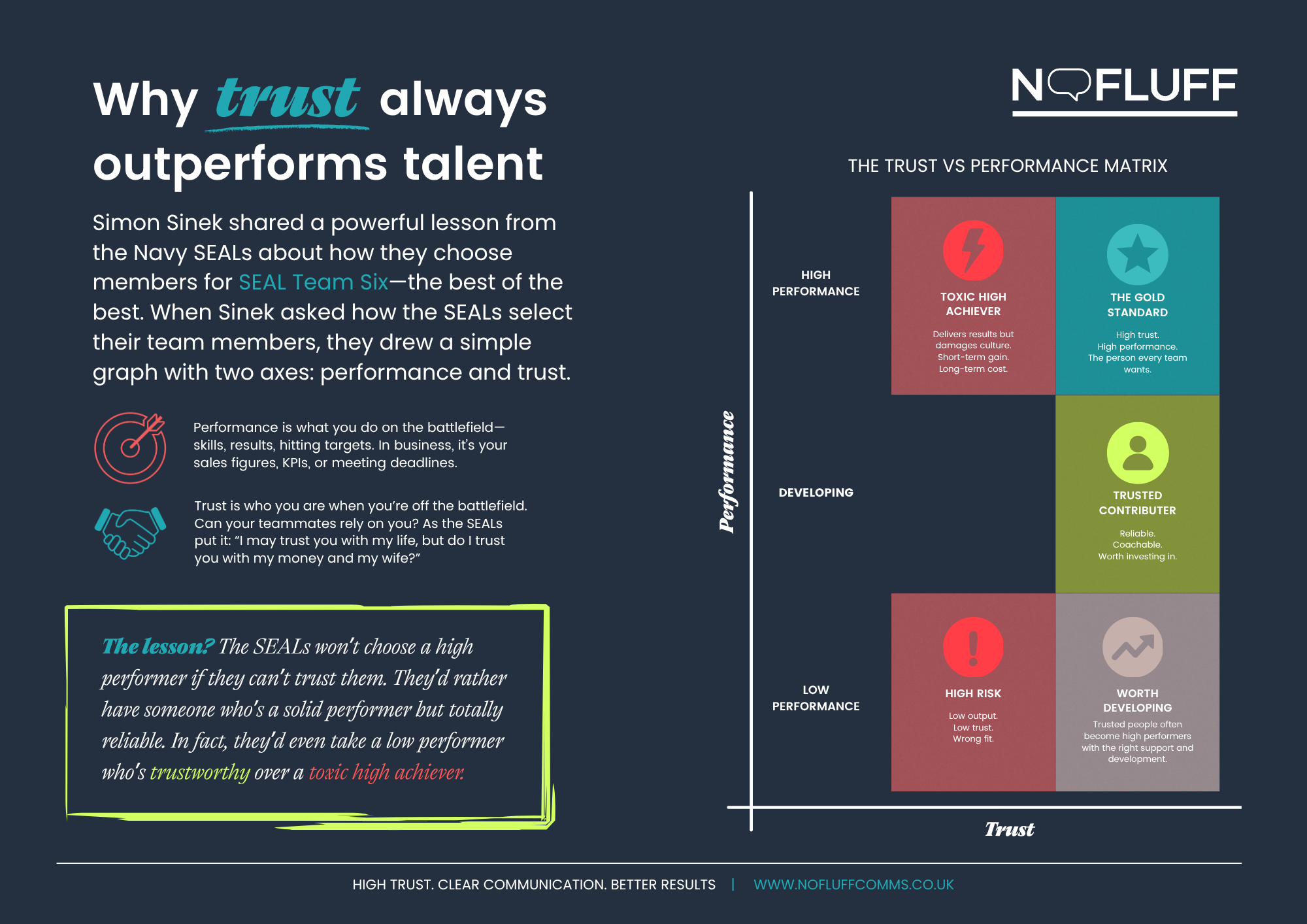
One of the ideas that has shaped my thinking comes from Simon Sinek, who shares a fascinating lesson from the Navy SEALs about how they select members for SEAL Team Six—the best of the best.
Rather than focusing solely on performance, they assess people on two simple measures: performance and trust.
Performance is about what you do—your skills, results and ability to deliver.
Trust is about who you are—your integrity, reliability and whether your teammates know they can depend on you.
The surprising part? The SEALs would rather have a trusted team member with developing skills than a brilliant performer who damages the surrounding culture.
As Simon Sinek puts it, trust beats talent in the long run.
Technical skills can be developed.
Integrity, attitude and a genuine commitment to others are much harder to teach.
It's a philosophy that resonates deeply with me.
I'd much rather build a team of trusted people who share the same values, support one another, and consistently deliver for clients than rely on someone who achieves impressive short-term results while leaving a trail of friction behind.
Because when trust is high, collaboration improves, accountability becomes easier, and high performance becomes sustainable—not just achievable.
High standards and empathy can exist together
There's a common misconception that supportive leaders somehow lower the performance bar.
I don't believe that's true.
In fact, I think the opposite is true.
The best leaders care deeply about their people because they want them to succeed. That means setting clear expectations, giving honest feedback and creating an environment where people know what's expected of them.
Support doesn't mean avoiding difficult conversations.
It means having those conversations with respect, fairness and a genuine desire to help someone grow.
One of the biggest mistakes I see, particularly with first-time managers, is believing they have to choose between being supportive and being accountable. Often, they're worried about being liked, so they avoid the conversations that really matter.
But leadership isn't about being everyone's friend.
It's about helping people become the best version of themselves, even when that means challenging them or having uncomfortable conversations.
The strongest leaders strike the right balance between autonomy and accountability. They trust people to own their work, but they're also present when they're needed—whether that's removing blockers, providing clarity or coaching someone through a challenge.
Because accountability shouldn't feel personal.
It should simply be part of a culture where everyone understands what success looks like and knows they're supported to achieve it.
Hire for attitude. Develop the skills
When I founded No Fluff Communications, I wanted to build something different.
Rather than creating a traditional agency structure, I built a trusted network of senior associates—people who are experts in their field but, more importantly, share the same values, service standards and commitment to looking after our clients.
One of the people I work most closely with didn't come from a traditional marketing background.
She came from customer service and retail.
Some people might have seen that as a weakness.
I saw it as one of her greatest strengths.
Yes, marketing skills can be taught.
But a genuine service mindset, curiosity, accountability, and an instinct to put the client first are far harder to develop.
That experience reinforced something I've believed throughout my career: technical skills get people in the room, but attitude, trust and values determine whether they'll thrive as part of a team.
It's also why I spend just as much time understanding how someone works as I do what they know. Can they be trusted to represent our business? Will they collaborate? Will they take ownership? Will they care about our clients as much as I do?
Because in a business built on relationships, every interaction shapes your reputation.
Skills can be developed.
Trust has to be earned.
You can teach marketing. It's much harder to teach someone to genuinely care.
Great workplaces aren’t built on free coffee
A gym.
A games room.
Free snacks.
They're all nice to have, but they're rarely the reason people choose to stay.
When it comes to building high-performing teams, perks might help attract attention, but they don't create commitment.
The best workplaces I've experienced invest in something far more valuable.
Their people.
They create opportunities to learn, develop and contribute. They encourage individuals to share ideas, challenge thinking and make a meaningful difference.
Most importantly, they make people feel seen, heard and trusted.
People want to know that their work matters. They want to feel that they're making a contribution, not simply completing a list of tasks.
That's what builds loyalty.
That's what builds trust.
And that's what creates the culture where high-performing teams thrive.
Because the best workplaces don't just invest in employee perks.
They invest in people—and people are what drive long-term business success.
Leadership is becoming more human, not less
Towards the end of the podcast, Anthony asked what I'm most curious about next.
My answer was easy.
Artificial intelligence is transforming the way we work, communicate and solve problems at incredible speed.
But while we're becoming more connected digitally than ever before, in many ways we're becoming less connected as people.
That tension fascinates me.
When it comes to building high-performing teams, I don't believe technology alone will ever be the answer.
The organisations that will thrive won't simply be the ones that adopt AI the fastest. They'll be the ones who use technology to remove repetitive tasks, creating more time for meaningful conversations, better leadership, and stronger relationships.
Because building high-performing teams isn't just about improving efficiency. It's about building trust, providing clarity, and helping people feel valued, supported, and connected.
Technology can automate tasks.
It can't replace trust.
Three questions every leader should ask
When it comes to building high-performing teams, leadership isn't about having all the answers. It's about asking better questions.
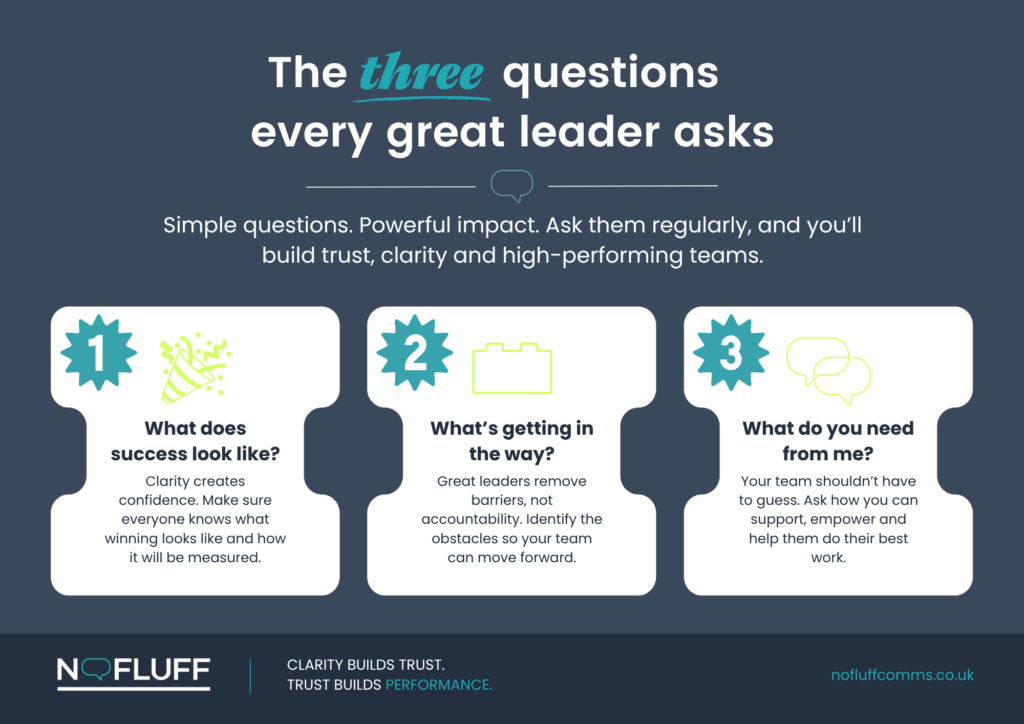
Whenever I'm leading a team, supporting a client or helping someone navigate a challenge, I come back to three simple questions:
What does success look like?
What's getting in the way?
What do you need from me?
They're simple questions, but they transform conversations.
They create clarity instead of confusion.
They encourage ownership instead of dependency.
Most importantly, they help leaders do what I believe is our real job: remove blockers so talented people can do their best work.
Because building high-performing teams isn't about controlling people. It's about creating an environment where people have the confidence, clarity and support to perform at their best.
Before your next team meeting, ask yourself:
☐ Does everyone know what success looks like?
☐ Have I removed unnecessary blockers?
☐ Am I measuring activity or outcomes?
☐ Do my team trust me enough to challenge my thinking?
☐ Have I asked what they need from me?
☐ Am I building trust as well as performance?
Key takeaway
Leadership isn’t about having all the answers. It’s about creating an environment where other people can find theirs.
Listen to the conversation
I thoroughly enjoyed joining Anthony Donovan on the Lead with Curiosity podcast to explore these topics in more depth.
Anthony has a genuine talent for asking thoughtful questions that encourage honest conversations rather than rehearsed answers, making the discussion feel exactly what leadership should be—curious, practical and centred on people. If leadership, culture, and building high-performing teams interest you, I’d highly recommend listening to the podcast, subscribing to future episodes, and connecting with Anthony on LinkedIn.
I’d love to hear your thoughts too.
What’s the biggest blocker you’ve removed for your team recently?
What to do next
If this kind of clarity matters to you, we share it regularly on LinkedIn through The Fluff vs The Stuff - our weekly take on marketing decisions that actually matter.
Prefer something more considered?
The No Fluff Brief is our monthly email with practical insight on marketing, PR and customer experience.
No spam. No waffle.

And if you’d rather talk it through, we’re always open to a conversation.